Key Points for Creating Messages for Emergencies
Introduction: Why Leave Messages?
Leaving messages for family and loved ones in case of emergency has meaning beyond just information sharing.
Three Reasons to Leave Messages:
-
Express Gratitude
- Words of thanks you're usually too embarrassed to say
- Thoughts about time spent together
- Expression of love for family
-
Share Practical Information
- Important contracts and procedure information
- Details about assets and insurance
- List of emergency contacts
-
Ease Anxiety for Those Left Behind
- Reduce confusion through clear intent
- Lessen bewilderment with specific instructions
- Provide emotional support through positive messages
Thus, final messages include both "emotional content" and "practical content."
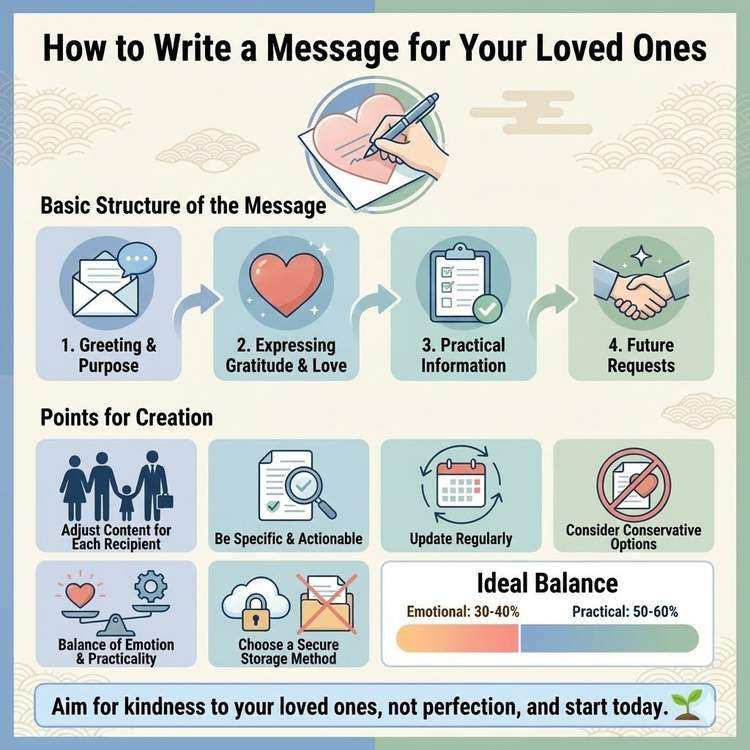
Basic Message Structure
Effective messages consist of four parts:
1. Opening Greeting and Message Purpose
If you're reading this message,
something must have happened to me.
I apologize for the sudden surprise.

This message contains my gratitude
and information I want you to know.
Purpose:
- Gently inform the situation
- Clarify the message's purpose
- Show consideration for the reader's feelings
2. Words of Gratitude and Love
This is the most important part. Express feelings you couldn't convey in daily life.
Writing Example:
Thank you for always being by my side.
Looking back on our life together,
every day was filled with happiness.

I'm truly grateful to have been your family.
Thank you for all the wonderful memories.
Key Points:
- Write in your own words, not formal language
- Include specific episodes
- Express positive feelings
- Write naturally as you'd speak
3. Practical Information
Share necessary information for procedures and daily life.
Information Categories:
Financial Information:
■ Bank Accounts
・XX Bank, XX Branch, Savings Account 1234567
  Balance: Approximately XX million yen
・YY Securities, Account Number: 7654321
  Assets: Approximately XX million yen

■ Insurance Contracts
・Life Insurance: XX Life, Policy Number XXXX-XXXX
  Insurance Amount: 10 million yen
  Contact: 0120-XXX-XXXX
Digital Accounts:
■ Major Service Account Information
・Email: xxxx@example.com
  Password: [Stored in safe]
・Cloud storage: Google Drive
  Important documents folder: "Important Documents"

■ Subscription Services
・Netflix: Auto-renewal, please cancel
・Amazon Prime: Auto-renewal, please cancel
Emergency Contacts:
■ People to Contact
・Attorney: XX Law Office, Tel: 03-XXXX-XXXX
・Tax Accountant: Mr./Ms. XX, Tel: 03-YYYY-YYYY
・Close Friend: Mr./Ms. XX, Tel: 090-ZZZZ-ZZZZ
4. Final Messages and Wishes for the Future
End with positive words of encouragement for the future.
Please continue living your life fully.
I'll always be watching over you.

Thank you for everything.
I truly love you.
Content Tips for Different Recipients
For Spouse
Focus:
- Gratitude for time together
- All asset and contract information
- Hopes for future life
- Expression of love
Example:
To my beloved wife,

Thank you for walking through life with me.
Every day with you was filled with happiness.

Below are important financial information and procedures.
Don't try to handle everything alone—
consult with the children and friends.

[Specific information]

Please continue living your life fully.
I'll always be watching over you.
For Children
Focus:
- Pride and expectations
- Memories of growing up together
- Life advice
- Message of love
Example:
To my beloved children,

I'm so proud of how you've grown.
Thank you for always being there for me.

From now on, support your mother
and live your own life fully.

[Memories and advice]

I believe in your future.
Always love you.
For Parents
Focus:
- Gratitude for raising you
- Apologies
- Message not to worry
- Words of filial love
Example:
Dear Father and Mother,

Thank you for raising me.
I've been able to come this far because of you both.

I'm sorry for leaving first.
Please don't grieve too much and take care of yourselves.

[Gratitude and memories]

Thank you for everything.
For Friends
Focus:
- Memories together
- Gratitude
- Request for family support
- Message of friendship
Example:
To my dear friend XX,

Thank you for all the good times.
Memories with you are my treasure.

If possible, please support my family occasionally.

[Specific memories]

Thank you for being my friend.
Message Writing Tips
Tip 1: Be Specific with Episodes
Rather than abstract expressions, include specific episodes and memories.
Weak Example:
Thank you for everything until now.
Good Example:
I'll never forget our first trip together 20 years ago.
Getting lost while traveling and laughing together
is now a precious memory.
Tip 2: Write in Your Own Words
Don't use formal or stiff language. Write as you would speak.
Weak Example:
I hereby express my deepest gratitude for your
unwavering support and kindness throughout the years.
Good Example:
Thank you for always being there for me.
I was truly happy to have you by my side.
Tip 3: Balance Emotion and Information
Keep both emotional and practical content balanced.
Recommended Ratio:
Emotional content: 40%
Practical information: 50%
Concluding message: 10%
Tip 4: Organize for Easy Reading
Use headings and bullet points for easy understanding.
Example:
■ Bank Account Information
・XX Bank, XX Branch
・Account Number: 1234567

■ Insurance Contracts
・XX Life Insurance
・Policy Number: XXXX-XXXX
Tip 5: Include Positive Messages
Avoid overly sad or negative expressions. Include forward-looking messages.
Weak Example:
I'm gone, but please don't be too sad.
Life will be difficult from now on.
Good Example:
Please continue living your life fully.
Create many happy memories from now on.
I'll always be watching over you.
Common Mistakes to Avoid
Mistake 1: Too Long
Messages that are too long are hard to read. Keep them concise and clear.
Guideline:
- For spouse: 2,000-3,000 characters
- For children: 1,000-1,500 characters
- For parents: 1,000-1,500 characters
- For friends: 500-1,000 characters
Mistake 2: Only Practical Information
Messages with only information lack warmth. Be sure to include emotional content.
Mistake 3: Ambiguous Instructions
Vague instructions can cause confusion.
Weak Example:
Important documents are somewhere in the house.
Good Example:
Important documents are in the second drawer
of the desk in the study, in the red file.
Mistake 4: Negative Messages
Avoid negative or critical content. Focus on positive messages.
Mistake 5: Not Updating
Review and update content periodically.
Update Timing:
- When financial situation changes
- When family structure changes
- When moving or changing jobs
- At least once a year
Using Dead Man's Switch for Efficient Message Management
Dead Man's Switch allows you to efficiently manage and deliver different content to multiple recipients.
Free Plan Features:
- Message creation and editing (unlimited)
- One recipient setting
- Automatic sending
- Two-factor authentication
Premium Plan Features:
- Multiple recipients (up to 5)
- File attachments
- Custom notifications
- Detailed logs
Summary
Messages for emergencies are important preparation to convey your feelings and information to loved ones.
Key Points:
- Balance emotional and practical content
- Write specifically and concretely
- Use your own words
- Include positive messages
- Review and update regularly
Don't aim for perfection. The important thing is to start.
Next article: "How Dead Man's Switch Works and How to Use It"
Related Articles:
- What is Digital End-of-Life Planning? Getting Started Guide
- How Dead Man's Switch Works and How to Use It
- Checklist of Important Information to Share with Family
Share This Article
About the Author
偽弟 (Gitei)
@danna6583973613 years in IT industry, 11 years as PM/PO. Designed and operated systems with 100M monthly visits, managed teams of 40+ members. Expert in E-commerce and enterprise systems, proficient in cryptographic protocols and authentication/authorization system design. Utilizes Claude Code and Gemini AI for secure, high-quality code implementation.
Learn More About the AuthorRelated Articles
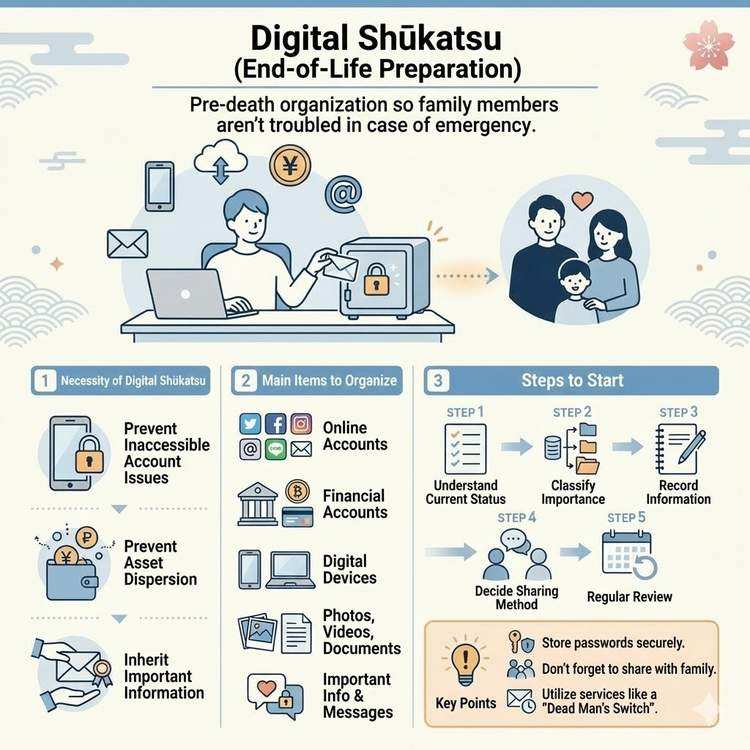
What is Digital End-of-Life Planning? A Complete Guide
Learn about digital end-of-life planning, from basic concepts to practical steps. Discover how to organize your digital legacy and manage important information for your loved ones.
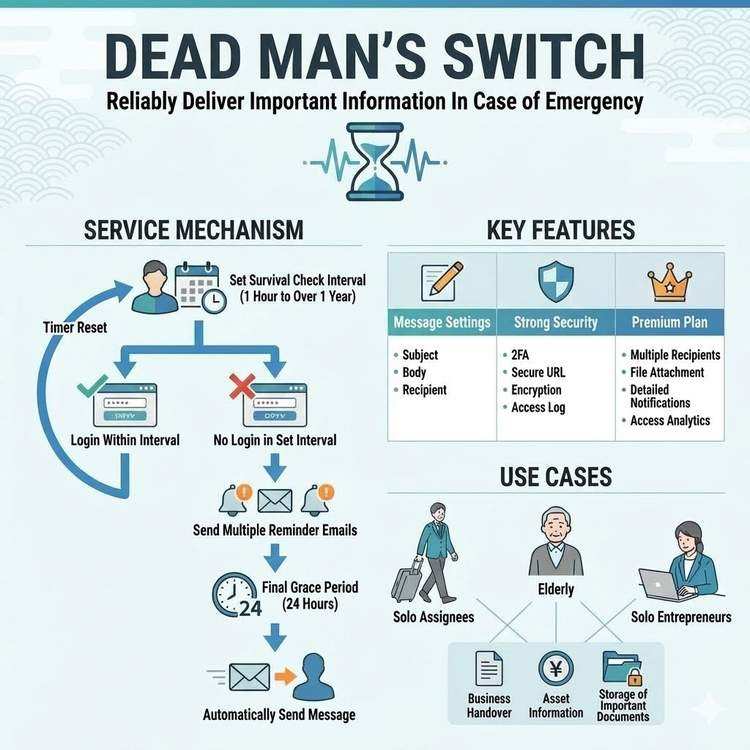
How Dead Man's Switch Works and How to Use It
A detailed explanation of Dead Man's Switch, from its technical mechanisms to practical usage. Understand the life check system and automatic delivery mechanism to use the service with confidence.
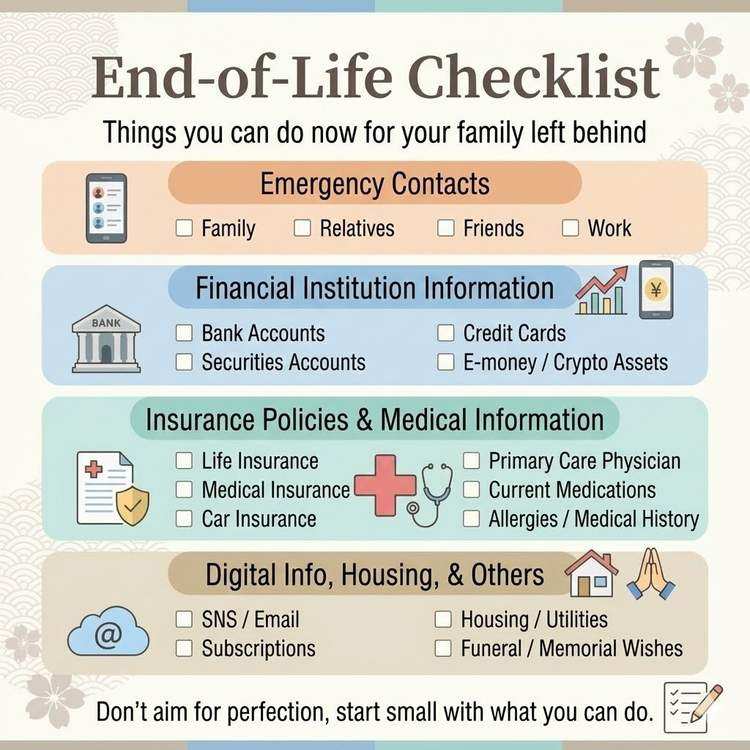
Essential Information Checklist for Your Family
A comprehensive checklist of critical information to share with your family in case of emergency. Follow this guide to ensure nothing important is overlooked.